

Any small-town teenager can tell you that for as long as they can remember, they feel like they’ve missed out. The “teenage dream” of a big city with infinite possibilities is portrayed in movies, TV shows, books, and the social media everyone consumes. The idea that their hometown is pulling them back for their full potential is at the back of their minds as they prepare for the next step of their lives. “I can’t wait to get out of here,” fills the hallways at school as students etch tally marks onto their calendars, waiting for graduation day, where they can finally fulfill their wish. Dragging on these years of their lives because they expect something greater deeply hurts students in the long run. Students should see the opportunities they have in West Virginia to not only further their appreciation of their home state, but also see it as a home they don’t need to escape.
“But Everyone Else is Leaving!”
As the years pass, there are fewer and fewer young people living in West Virginia. According to the Census Reporter, the median age in West Virginia is between 42.7 and 42.9 years old. With that, the younger population between 0 and 19 years old has dropped to a staggering 23%. Knowing these statistics, students see their peers going off to faraway states and feel they should too. “If everyone my age sees nothing here, why should I?” It’s a self-fulfilling prophecy, where no one feels the need to solve the problem at its roots.
Mrs. Dobrzynski, a social studies teacher here at Wheeling Park, expressed why she decided to stay in West Virginia, “It was about doing something meaningful, helping and giving back to the place and people that I love,” said Dobrzynski. “I don’t know how we’re going to fix anything wrong if we’re not willing to stay and try to do it, and I think there’s no better way than the next generation.”
Some young people share Mrs. Dobrzynski’s ideals in fulfilling their civic responsibilities, such as Mariana Alkhouri, Wheeling Park class of 2023 graduate. Even after being accepted to several out-of-state universities, she decided to stay in-state and study immunology at West Virginia University. She explained her decisions, “I believe it was a way to fulfill my civic responsibility,” said Alkhouri. “Ultimately, the fate of West Virginia depends on whether young people choose to invest in studying, working, and living here.”
“But Our Schools Are Terrible!”
West Virginia doesn’t have a great track record in education. According to U.S News, the state is ranked #47 in education, with pre-K12 education ranked at #46 and higher education at #40. With such low rankings, students are troubled by the fact that they may not be receiving the greatest undergraduate education. While these concerns are relevant, there are a plethora of reasons why rankings shouldn’t be the only deciding factor for studying in-state.
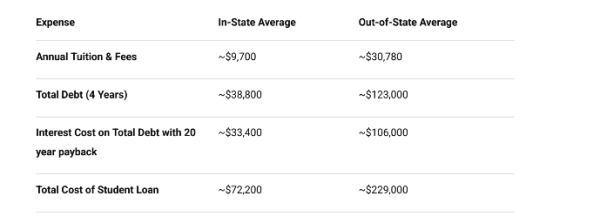
Student loans are a major contributor to the total U.S. household debt. Students might not understand how much student debt will bind them after graduation. Mr Michaels, personal finance teacher at Wheeling Park, added to the financial benefits of staying in state, “It is financially better to attend an in-state college in West Virginia because residents pay an average of $8,715 to $10,752 per year in tuition, which is roughly one-third of the cost to go to an out-of-state college,” said Michaels. “By staying in-state, students gain access to the PROMISE Scholarship, which can cover up to $5,500 of annual costs, and the West Virginia Invests grant, which can make community college tuition-free. Additionally, most students can commute to a nearby college, thereby avoiding another $15,000 in room and board fees that would be incurred if a student were to attend an out-of-state school.”
In addition to the financial benefits, students aren’t missing out on much during their undergraduate education. Mrs. Mathieu, one of Park’s school counselors who helps with application assistance, explained how an in-state undergraduate education doesn’t set students far back. “Knowing you may have to pay for a Master’s or Doctorate, finding an affordable undergrad degree is critical,” said Mathieu. “I’ve also known many students who have gone in-state for undergrad but then gone to Law school or Med school out of state. Their education in-state did prepare them to be a competitive candidate.”
Finally, staying at an in-state school can provide students with educational opportunities that are not found elsewhere. Alkhouri also shared the educational benefits that came with staying in state to study her major, “Undergraduate students rarely have the opportunity to study what is actually a medical school level topic, and I am glad I seized that chance to have graduate level knowledge early in my career,” said Alkhouri. “I found a great opportunity to be a leader in my state. I was drawn to WVU for its immunology and medical microbiology program. Being in the program gave me access to do research under my professors, as well as to be trained in a highly relevant and burgeoning field.”
“But There’s Nothing For Me After College!”
Since the pandemic, there has been stagnant job growth in the state. According to WVU edu, there have been significant job losses in sectors such as mining, government, and retail, and the unemployment rate in the state has increased to 3.8%. This leads to major concerns in the younger generation about their futures in the state. Ultimately, they believe that they’ll have to get out of here at some point, so why not right after high school? As Mrs. Dobrzynski described it, “I think a lot of young people in West Virginia grow up hearing that success means leaving and big cities mean better opportunities,” said Dobrzynski. “Some of their concerns are real, like the job availability, depending on what they want to be, or the salary. Students talk about wanting to leave, not because they don’t like West Virginia, but because they have a hard time envisioning a future here.”
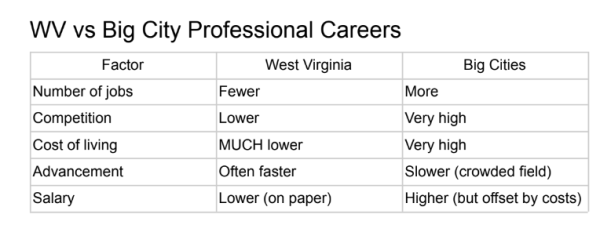
While it is true that there has been a job decay in certain fields, many professions have found growth in the state. As Michaels explained it, “There are fewer jobs in SOME fields, but strong demand in OTHERS.”
Michaels has taught that the fastest-growing employment sectors in West Virginia are IT and high tech, healthcare, advanced manufacturing, skilled trades, construction, and infrastructure. For example, in healthcare, doctors, nurse practitioners, pharmacists, and dentists are in huge demand to meet the needs of the older population and to offer help to rural areas. Additionally, business leaders and managers in fields such as manufacturing, healthcare, retail, and logistics are always needed to run a company successfully. Students can move into leadership roles quickly due to smaller organizations
As young people leave to find their careers, they fail to see the opportunities that are right here at home. The truth is that West Virginia doesn’t have a job shortage; it has a labor shortage.
Students must also factor in that the cost of living in West Virginia is pennies compared to the big cities they aspire to go to. That, coupled with the growing demand for high-paying jobs, can allow young people who are budding into adulthood to lead a comfortable lifestyle right here in the state. As Michaels said, “The honest bottom line is that, yes, West Virginia has fewer corporate and ‘prestige’ roles. But, it has strong demand for core professional careers, and in many cases, less competition and a lower cost of living can bring about a better quality of life.”
The idea that staying in West Virginia is a lost cause is a myth. It is the responsibility of students and young people to take charge and improve this wonderful state. Even if life takes them to new and wonderful places, it is the effort they put in to try to help West Virginia that matters. In this college decision season, don’t overlook the opportunities that are right here at home.