

When Given the Choice of Saving the Planet or Using AI, Which Will You Choose?
As artificial intelligence continues to evolve every day, taking a step back allows us to better examine the consequences it exacerbates- for better or for worse. By its definition, artificial intelligence is programmed and designed to assist with tasks that would otherwise require human intelligence. However, as artificial intelligence becomes more integrated and prominent in people’s everyday lives, the application of its very definition has begun to shift. Rather than its intended purpose of simply supporting and improving human thinking, it replaces human intelligence through critical thinking, creativity, and introspection altogether.
Taking a step back, we can also examine how artificial intelligence isn’t inherently harmful. In fact, many students and even educators can recognize its benefit when used appropriately. Ms. Mathieu, a counselor and Speech & Debate coach at Wheeling Park High School, emphasized that AI is not the problem, instead it’s the consumers.
“I don’t think it [AI] is inherently bad, I do definitely think there are good uses for it,” said Ms. Mathieu.
In explaining this, it’s clear that artificial intelligence is there to be a helpful tool in aiding students and teachers, but it falls short due to the application of its definition. There are many facets that show that AI actually helps decrease the workload on many people, including educators, when used responsibly.
“I know personally that for me, there are times where I have to write a welcome to an award ceremony or something, and I do think it helps take away from my workload,” said Ms. Mathieu.
However, the true issue really arises when artificial intelligence is being abused and overused. Artificial Intelligence is meant to be a tool, not a crutch that students rely on. This problem dominates in the school system where students increasingly rely on AI, not as a study aid, but as a full replacement of learning.
This overuse pushes another issue to the forefront. Behind every AI- generated response, image, and video, are data centers that consume enormous amounts of electricity and water, driving environmental impacts through the roof.
One of the most pressing environmental issues surrounding artificial intelligence is its footprint on ecosystems. Just because someone isn’t using AI doesn’t mean the person next to them isn’t using the amount for both of them. AI models run constantly in these data centers and require a significant amount of energy, time, and even water to properly operate in order to meet the needs of the millions of people relying on them.
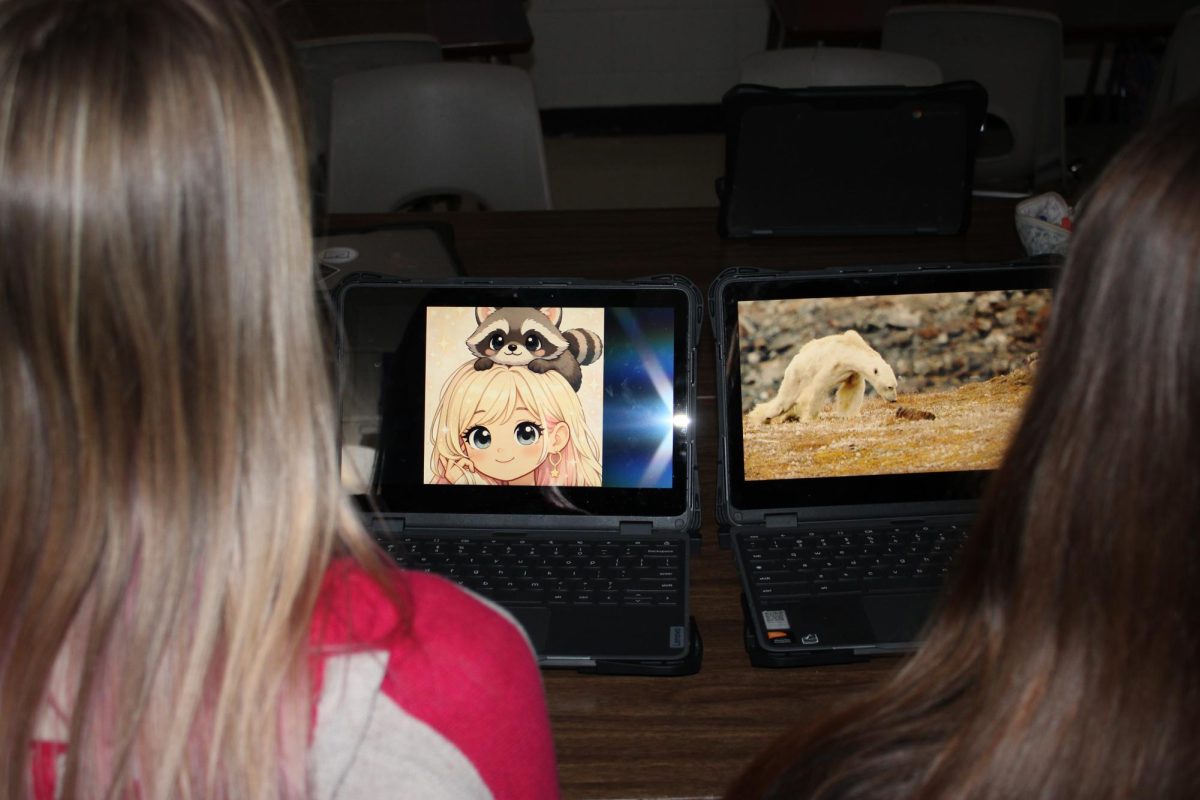
From AI photo generations of a cartoon version of someone with a raccoon and sparkles on their head to drafting an email to someone. The overuse of artificial intelligence is pushing the globe towards a future of increased climate change and environmental degradation.
“I’m so annoyed by this trend right now of everyone making those AI, cartoony pictures,” said Ms. Mathieu.
While some of these silly images may seem harmless or entertaining for some, they require an extensive amount of computing behind the scenes. Now, just imagine millions of people all over the world creating these same AI-induced photos for fun; the overall environmental cost weighs more than any artificially created image.
Senior Jana Schodzinski puts the perfect highlight on one of the leading concerns within the umbrella of environmental impacts: water usage.
“AI data centers specifically take up a ton of energy and water, using water to cool off their energy systems, and then the water isn’t able to be used for future use,” said Schodzinski.
In a world already experiencing water scarcity, climate instability and change, and even droughts across many states, the diversion of this water is key.
Earth and space science teacher Mrs. Dixon helps put this in perspective.
“I absolutely feel that AI has some negative impacts on the environment. The generator uses water to power the systems, and it also releases carbon emissions,” said Mrs. Dixon.
Even despite these consequences, many generations older than high school students find themselves completely unaware of the pressing environmental issues of their AI usage.
“My generation and generations older than me use it very wastefully and can be destructive both to their educational growth and the environment,” said Ms. Mathieu.
Older generations often find themselves utilizing technology and AI productively in the workplace, but many don’t understand the true scope of the issue.
“Teachers and adults have also been using ChatGPT, like I know for my parents, it’s become part of their work day,” said senior Taylor Miller.
While this can sometimes be beneficial to many sectors of work, they reflect a much broader trend of the normalization of artificial intelligence. As AI becomes more prominent in the workplace routines, the environmental costs match that.
This reliance is not only seen in educators and workplaces, but also in school systems, where students find a tool and abuse it. In rural states like West Virginia, where the literacy and reading comprehension rates are at an all-time low, AI doesn’t solve; it exacerbates those rates.
“In rural states like WV, students are already facing an educational and literacy crisis where they’re already facing academic struggles at rates disproportionate to those students in more suburban or urban areas,” said Schodzinski.
When students choose dependency, they choose not to fully apply the information they have been taught. Artificial intelligence shouldn’t be a dependable factor for students, because it is prone to inaccuracies.
Even though AI is currently evolving, it hasn’t fully developed. Instead, it provides misinformation and biases to users, furthering the long-term consequences.
“I do think that with all the mistakes that AI has been having a track record of making, that’s gonna lead to a lot of problems down the road,” said Miller.
Ultimately, the question isn’t whether or not artificial intelligence should exist, but rather how it should be applied. Along with the application should also come awareness of the environmental strain it is causing to the globe. As climate change is already accelerating due to projected concerns, society must consider whether the environment means more than AI-created images.
“If we are strategic on how we use AI, we could easily reduce some of the negative impacts. With current trends, people are using it to create AI images or to answer simple questions. AI is not going away anytime soon, but we need to be more conscientious about how we are using it,” said Mrs. Dixon.
So, the answer to the question: When given the Choice of saving the Planet or using AI, Which Will You Choose? It should not be difficult, because without the environment, AI wouldn’t even be a choice.